Story for the Week
As the end of the year approaches (yes, there are only nine and a half weeks until Christmas), I’m hoping the books I have on my TBR are better than the last few I’ve read. Apparently, I have not chosen well for the second half of the year.
The order of my posts does not always reflect reading order. Sometimes I’ll have something written and drafted and have to move it to fit in an ARC that I picked up. I have reviews scheduled in November for books by Amanda Prowse that I read in June for exactly that reason. I read The Wedding People in July and ended up pushing that review to September (Finding Book Recommendations in the Wild).
Sometimes I plan books for a specific day because there’s a natural tie in (Six Years Later, Still Seeing Constant Reminders of You and What a Difference Twenty-One Years Make). Sometimes I read books earlier because I’m ahead of schedule and “someone” (aka Jo) asks me to read something early because she wants to know whether I liked it and doesn’t have the patience to wait. 🤔
Since July, I’ve rated half of the books I’ve read 3 stars or less. The last three alone were either 2 or 2.5 stars. 😬 Jo suggested that I need a good thriller. Unfortunately, of the books I have scheduled to read for the remainder of the year, only the last one in December is a thriller. But based on what I have scheduled, I’m hopeful.
There’s a lot of discourse on social media about whether it’s worth it to keep reading a book you aren’t enjoying. If I didn’t do reviews and need to have something prepared every week, I might be more inclined to stop reading some books. But I also don’t like the idea of sugar-coating my blog by only reviewing things that I rate 4 or 5 stars. I mean, the heading on this page literally says “Books I love, books I don’t, and everything in between.” There are plenty of books I loved that other people disliked and vice versa.
In fact, even before I started this blog, I reviewed a book on Goodreads that I rated 2 stars in 2018. It has more likes and comments than any of my other Goodreads posts—as recently as this past August. I received an advance copy as a Goodreads giveaway and never went back to that author, but people are clearly still reading that book. That makes me feel like people appreciate the not-so-great reviews as much as they appreciate the 5-star reviews.
Some people subscribe to the philosophy that you can still rate a book that you didn’t finish. In fairness, NetGalley actually does allow that option, assuming that you feel you read enough to offer a constructive opinion. The alternative is to not rate or review it and mark that you choose not to leave feedback on a title. It seems the main reason reviewers don’t choose that option is to save their feedback ratio. But I have seen a number of reviews where someone gets 10-20% of the way through a book and doesn’t finish and still gives a rating. That’s their prerogative, but let me explain why that will never be me.
I have read plenty of books that I considered a slow burn. The author takes time to create a back story, and the action really begins later in the book. They start slow but hold my interest, and by the end, I can’t put them down. If I give up on a book 10-20% of the way in, unless it’s the writing style I don’t care for, I hold out hope that the story will get better.
I equate it to a teacher grading a 100-question test and failing a student after grading the first 20 questions. What if the student doesn’t test well? What if they know the material at the end of the test better? Failing them without grading every question isn’t fair. I feel the same way about books. If I choose not to finish a book (which rarely happens), I don’t think it’s fair to rate or review it because I don’t have all the information to make a judgment.
As far as NetGalley is concerned, I also feel a sense of obligation to review everything I’m approved for because I made the request. Only 10 of the ARCs I requested in the last eight years have landed in the “will not give feedback” category. Some of them I may go back to at some point because it might have been formatting issues or something not related to the book itself. Two of them I know for sure I won’t go back to. But the point is I really do try not to DNF a book. Unfortunately, sometimes that causes a rash of not-so-great reviews.
And now seems like a good opportunity to explain what my ratings actually mean…for me, because everyone’s rating scale is different. For the record, I go into every book hoping it’s going to be a 5-star read. If something gets a half star, it’s usually because I couldn’t decide between the two, and sometimes I can’t identify the thing that’s holding me back from the higher rating. I just know there’s something keeping me from bumping it up.
Then there are the books that I’ll start writing the review for and actually change my rating up or down—usually down. It’s unusual, but it happens when I start writing a review and remember more things that bothered me about a book. This almost always happens with books that had a half-star, and I end up taking away the half-star.
⭐ – didn’t like it at all, would not recommend
⭐⭐ – didn’t care for it but had a decent premise, maybe not executed well
⭐⭐⭐ – it was ok, didn’t hate it, didn’t love it, could take it or leave it, it passed the time
⭐⭐⭐⭐ – really liked it, great story, well written, good character development, would recommend
⭐⭐⭐⭐⭐ – loved it, consider it a must-read, leaves me wanting more of the same, may have to take a beat before I start something else, immediately comes to mind when someone asks for a recommendation
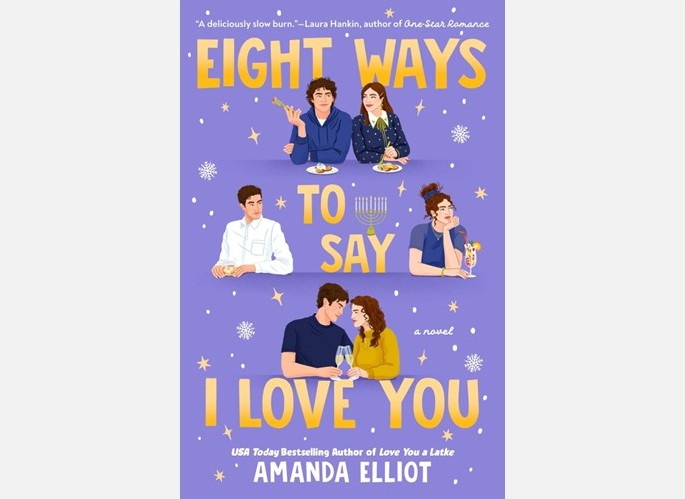
I remember telling Jo when I was about 17% of the way through the book below that it would not be receiving a great review. And at 53%, I knew this would be the theme of the post when the female main character was designing a book cover and someone told her that the art was really good. “She wished she could say the same about the book. Though she’d promised to read the whole thing, she’d barely managed to plod through the first third.” 😬 I plodded through the first third and the second third and even the third third. At least I finished, which is more than I can say for the FMC.
Book Review
⭐⭐½
2.5 Stars for Eight Ways to Say I Love You by Amanda Elliot
384 pages
Publisher: Berkley
Publication Date: October 27, 2026
I received an advance copy of this title from Berkley via NetGalley.
Publisher’s Description
This Hanukkah, Shira Levinson is returning home to New Jersey riding the high of achieving major milestones. Though she only just graduated from college, she’s got her dream job and a perfect Los Angeles apartment—an actual miracle in the city of dreams.
Life has not been quite as kind to Leo David. Not only did he fail out of college, he was forced to move in with his estranged dad, who he still hates for cheating on his mom years ago. The only silver lining? Getting to see Shira, his childhood friend (and crush, though he’ll never tell her that) while she’s home for her family’s holiday party.
But that’s just the beginning. Over the next eight years, Shira’s and Leo’s lives spin them in all sorts of directions as they grow and change, taking them places they never imagined going. Sometimes those paths take them farther away from each other, and other times closer together. If they can only time it right, they might uncover a love that burns forever.
************
Main Characters:
- Shira Levinson – an artist, 14 years old when her best friend Leo moved to Michigan with his mom, went from her home in New Jersey to college in New York to living in Los Angeles at 22 years old where she works in an art gallery and also wants to create her own gallery show
- Leo David – 14 years old when he moved to Michigan with his mom after his father admitted to having an affair, struggled in college, moved back to New Jersey when his mom got together with someone new and moved out of the country, works in a warehouse at 22 and is still estranged from his dad even though they live in the same house
This truly is the time of year for holiday romances. I’ve always been a sucker for a predictable Hallmark movie, and I don’t shy away from predictable holiday books either. This is not my first Hanukkah romance. That said, it will probably, sadly, be my last by this author. I feel like the story itself had a lot of potential. The execution, however, lacked something for me.
The story is told in dual points of view over the course of eight years, beginning eight years after Leo moves away with his mom after his dad admits to an affair. From the time Leo moved at 14 until they are both 22, Leo and Shira seem to have completely lost touch. When Shira comes home to New Jersey for the holiday and the annual Hanukkah party she hosts for the neighborhood with her family, she finds out that Leo actually moved back in with his dad…basically because he had nowhere else to go.
Over the next eight years, they come together for the Hanukkah party when Shira comes home. We get snippets in between the holidays, which is one of the elements I don’t think worked, but the majority of the storytelling takes place leading up to each Hanukkah party.
First, I’ll talk about what I liked. I really enjoyed all of the Jewish elements the author weaved into the story. While the narration takes place over a single holiday each year, Shira spends some time teaching Leo about Jewish customs since his mom isn’t Jewish and his dad isn’t a practicing Jew. As a non-Jewish reader, I appreciate the way the author worked in those elements. I like the intentional theme around the number eight. The title and the eight years covered in the timeline of the book tie in really well with Hanukkah being eight days and nights.
I also love Leo as a character. He goes from reactive teen to kind of a lost young adult, but he has an amazing growth story. His demeanor is something I would definitely want in a partner and a friend. He always seems to think about the other people in his life and has to learn to put himself first. But he is a great friend and a kind person. His development was my favorite, followed by Shira’s younger sister who, even though she isn’t a main character, really develops in a great way from high school teenager to adulthood.
Shira, on the other hand, is super self-absorbed. I know the idea is for her to become less self-absorbed and learn that life is not all about appearances, but she is really an insufferable character for the vast majority of the book. By the time she becomes someone who meshes with Leo, I could not get past how horrible she had been. She looks down on him for most of the book, almost like he’s below her station or something.
Between the chapters that tell the story of the Hanukkah party each year, the author weaves in a single chapter with small exchanges from the remainder of the year. There are text exchanges between Shira and Leo, e-mails to and from them that tell you a little bit about what’s happening in their lives outside of the holiday reunion. I wish these had been better developed because we might have seen more of the banter that you expect from a romance and was really lacking here.
By far, the best banter in the book came more than halfway through when Leo offers to take on the responsibility of the Hanukkah party and hires a caterer. He asks Shira if crème fraîche can be substituted for sour cream for the latkes.
“Shira’s response. He didn’t have to squint to read it, because it was in all caps. ARE YOU KIDDING? NO, CRÈME FRAÎCHE IS NOT AN ACCEPTABLE ALTERNATIVE TO SOUR CREAM WHEN IT COMES TO LATKES. FIRE YOUR FANCY CATERER.
Emily’s soft auburn hair brushed his cheek. ‘She has very strong feelings about latkes.’
‘And Hanukkah food in general.’ Leo grinned and typed back, Got it, thanks. So I’m guessing Cronuts in place of donuts is also a no?
Typing bubbles rose and then fell away, then rose again, then disappeared again. Probably because it was hard to type while your head was exploding. She finally responded with You’re dead to me.”
Aside from that, there are logistical things in the story that didn’t make sense or pulled me out of the story. For example, the first year, Shira takes on the challenge of making all of the latkes for the party—200 in total. She and Leo determine they will need 60-70 pounds of potatoes. She then says that they probably need “a few” onions and that her parents have eggs at the house.
Now, I’ve never had latkes, let alone made them, but it strikes me as a little off that they would only need a few onions and that they have enough eggs in the house to make 200 latkes. So I searched for recipes, and it’s likely that they would have needed a couple dozen onions and about four dozen eggs. That is way more than “a few,” and I doubt Shira’s parents had four dozen eggs on hand.
Shira also consistently complains about Los Angeles. She doesn’t like the food culture. She doesn’t like the weather. Everyone does yoga and Pilates in LA, but she finds them too expensive so she tells everyone she’s a runner. Living in LA, she thinks stores like Kohl’s, Petco, Dressbarn, and Applebee’s had gone out of business. What’s most surprising about how much she seems to dislike LA is that she chose LA in the first place in order to make it in the art world. She went to school in New York, which is easily commutable from New Jersey. There are significantly more art galleries in New York than in LA, including the largest gallery in the U.S. Why in the world would she choose to go to LA?
I also feel like the author takes a few not-so-subtle jabs at non-Jewish people. For example, there are three references to the fact that Hanukkah isn’t really an important holiday but makes it sound like non-Jews assign more importance based on Christian holidays. One of them says, “Hanukkah isn’t actually an important holiday, you know, it’s just that non-Jews think it’s the most important holiday for us because it’s right around Christmas.” Later: “Shira was still talking about the Hanukkah story, something about the morals and the meaning and the fact that it wasn’t a very important holiday after all, that general American society just thought it was important because of its proximity to Christmas, and people felt bad that only the Christian kids got presents.”
Another jab: “People are always accusing us of stealing things. Like Jewish and Israeli food! Jews have been in the Middle East and North Africa for thousands of years. So yeah, when we got kicked out of all those countries, we took our food with us wherever we ended up. It’s our food, too.”
And yet another jab: “Just because there weren’t any swastika bumper stickers or Klan rallies happening on Sundays didn’t mean she had any idea what prejudices simmered behind closed doors.”
😬 I get it…prejudice exists. It exists across the board, though, and I don’t expect a romance to throw that kind of thing in my face.
All in all, while I appreciate the sentiment behind the book and thought it had a lot of potential, it’s a miss for me.
If you enjoyed this post, please comment below. Subscribe for regular updates, and share it with your friends. If you’re interested in starting a conversation, send an email to booksundertheblanket@gmail.com.
As an Amazon affiliate, I earn a small commission at no cost to you when you make a purchase using the links on my site.